
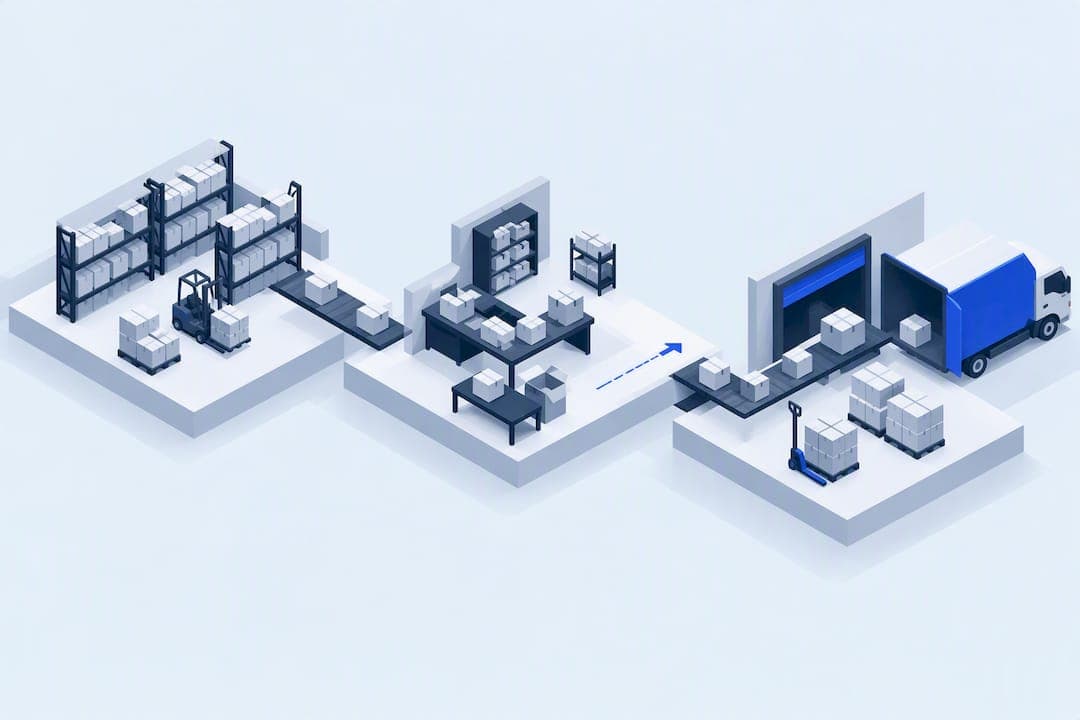
The pick and pack process is the warehouse workflow that selects ordered items from storage and prepares them for shipment. Done well, it cuts order cycle time, shrinks costly picking errors, and lowers cost per order across the board. It sits between receiving and shipping, and it's usually where fulfillment operations either earn customer trust or lose it. Standards like GS1 barcode guidance and packaging rules under Lithuania's GPAIS registry both shape how a compliant, efficient version of this workflow actually runs, and tools like OrderKrab exist specifically to remove the manual friction from it.
TL;DR:
- Batch picking is recommended as the default method, with wave picking only during peak weeks to avoid unnecessary scheduling complexity.
- Implementing scan-to-verify at packing and choosing appropriately sized boxes can significantly reduce returns due to errors and minimize shipping costs.
- Mobile barcode scanning and seamless WMS/OMS integration are crucial in catching pick errors immediately and automating labeling and carrier selection.
- Proper slotting and routing strategies based on SKU velocity and order size can reduce cycle times from over four minutes to just over a minute per order line.
- Focusing on key KPIs such as pick accuracy, order cycle time, and return rate allows accurate identification of process weaknesses and targeted improvements.
Table of Contents
- What Is Pick and Pack? Mapping the Order Fulfillment Process
- Warehouse Picking Methods: Choosing the Right Approach
- Packing Best Practices That Cut Returns and Shipping Cost
- Technology and Integrations Behind a Reliable Pick Pack Ship Process
- Slotting, Batching, and Routing: Optimizing the Warehouse Floor
- KPIs That Actually Tell You Where Pick and Pack Is Breaking Down
- Packaging Compliance: EPR and GPAIS Obligations for Online Sellers
- How OrderKrab Fits Into the Pick and Pack Workflow
- Common Pick and Pack Errors and How to Prevent Them
- Training and Workforce Management for Pick and Pack Teams
- Why Pick and Pack Accuracy Drives Customer Satisfaction and Returns
- Cost Breakdown: What Pick and Pack Actually Costs Your Business
- A 30/60/90 Day Plan for Fixing Pick and Pack
- Get Started With OrderKrab's Pick and Pack Software
- Sources
- FAQ
What Is Pick and Pack? Mapping the Order Fulfillment Process
Every order that leaves a warehouse passes through five connected stages, and a breakdown at any single handoff shows up as a delay or an error somewhere downstream. Understanding where your operation actually loses time starts with breaking the pick pack and ship process into its component parts.
- Receiving. Inbound stock gets checked against purchase orders, counted, and inspected for damage. A missed scan here means your system thinks you have inventory you don't, which shows up three weeks later as a canceled order.
- Put-away. Items move from the receiving dock to their storage slot. Incorrect put-away, placing a SKU in the wrong bin, is one of the most common and hardest to trace warehouse errors, because the system says the item is in Slot A while it's physically sitting in Slot D.
- Picking. A picker (or a robot, in more automated setups) retrieves the ordered items using a pick list. This is where most labor hours in a warehouse actually go.
- Packing. Items get verified, boxed, cushioned, and labeled for their carrier.
- Shipping. The package is manifested, handed to the carrier, and tracking data flows back to the customer.
To audit these stages in a single shift, walk the floor with a stopwatch and a clipboard. Time how long a picker takes from list to cart, watch whether packers actually scan every item before sealing a box, and check whether your receiving team reconciles counts the same day stock arrives. Most accuracy problems trace back to a skipped scan at put-away or packing, not a systemic flaw in the order fulfillment process itself.
Warehouse Picking Methods: Choosing the Right Approach
Picking method choice depends almost entirely on your average order size, how many SKUs you carry, and how much your volume swings during peak periods. Getting this wrong is expensive: order picking accounts for a large share of warehouse operating costs in many operations, so the method you choose has an outsized effect on your bottom line.
- Single-order picking sends one picker to fulfill one order start to finish. It's simple and accurate but slow at scale, best for low-volume operations or high-value, low-error-tolerance items.
- Batch picking groups multiple orders into one picking run, cutting travel time when order lines overlap heavily. It works well when many customers order the same handful of popular SKUs.
- Wave picking releases groups of orders on a schedule tied to shipping cutoffs or carrier pickup times, useful when you're coordinating picking with a tight truck departure window.
- Zone picking assigns pickers to fixed warehouse zones, and orders pass between zones as items get added. It scales well in large facilities but adds handoff risk.
- Picker-to-part (the traditional model) sends people to inventory. Part-to-picker, using conveyors or automated storage systems, brings inventory to a stationary picker, dramatically cutting walk time at higher upfront cost.
Pro Tip: Run batch picking as your default and switch to wave picking only during peak weeks when carrier cutoff times start dictating your schedule. Trying to run wave picking year round adds scheduling overhead most small and mid-size operations don't need.
Order profile matters more than warehouse size here. An operation with three average lines per order and 200 SKUs behaves very differently than one running single-item orders across 10,000 SKUs, and no single method fits both.
Packing Best Practices That Cut Returns and Shipping Cost
A packing station should never let a box get sealed without verification. Scan-to-verify, where a packer scans every item against the digital order before it goes in the box, catches the substitution errors that single-order picking alone can't prevent. Weight checks at the point of packing flag missing items before they ever reach a customer's doorstep, and photo evidence at packing has become standard practice for high-value orders because it resolves "item not received" disputes in seconds instead of days.
Right-sizing packaging matters more than most operators realize, largely because of dimensional weight pricing. Carriers charge based on package volume, not just actual weight, so a slightly oversized box on a light item can cost more to ship than a heavier item in a properly sized one. A pack station stocked with three or four box sizes, rather than one default box for everything, usually pays for itself within a quarter.
Packing station checklist:
- Scan every item against the order before sealing, not after
- Weigh the sealed package and flag variances outside expected range
- Choose the smallest box that protects the product, not the closest one on the shelf
- Place the shipping label flat, fully visible, and away from seams or box edges
- Use protective materials sized to the void, not stuffed in as an afterthought
- Match the manifest to the physical label before handoff to the carrier
Label placement also affects scan reliability at every sorting point the package passes through on its way to the customer, which is a detail packing teams frequently overlook.
Technology and Integrations Behind a Reliable Pick Pack Ship Process
The technology stack underneath pick and pack determines whether errors get caught in seconds or discovered three days later in a customer complaint. A warehouse management system (WMS) or order management system (OMS) needs to talk cleanly to your storefront, your inventory counts, and your carriers, because any gap between those systems is where orders go missing or ship wrong.
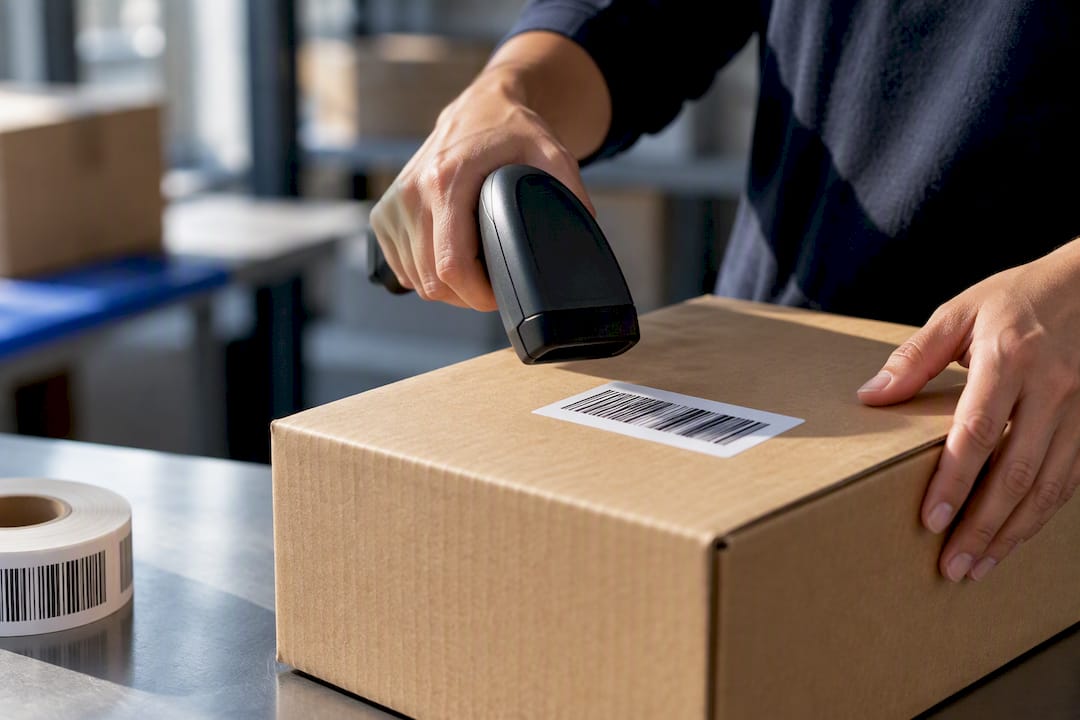
Mobile picking apps with barcode scanning remove the single biggest source of pick errors: relying on a person to visually match a SKU number on paper. When a picker scans a barcode and the app confirms the match before allowing the item into the tote, mis-picks drop sharply. This matters even more with GS1 2D barcodes, which can now encode batch, lot, and expiry data directly into the barcode itself, letting a WMS enforce first-expired-first-out picking automatically rather than relying on a picker to check a printed date.
- WMS/OMS integration with checkout systems, so inventory updates the instant an order is placed
- Mobile scanning at pick and pack to confirm every item before it leaves the shelf
- Automated label printing tied directly to the order, not a manual lookup step
- Multi-carrier integrations that let a warehouse choose the cheapest or fastest option per shipment
Carrier connectivity deserves its own attention. A warehouse running Venipak alongside international carriers needs label generation that adapts automatically to whichever carrier the order requires, without a staff member manually re-entering address data into a separate portal each time.
Barcode print quality is not a minor detail either. GS1's placement guidance recommends high-contrast symbols placed away from box seams and edges, because a scanner that can't read a crumpled or poorly printed barcode forces a manual override, which is exactly the kind of step that introduces human error back into an otherwise automated flow.
Slotting, Batching, and Routing: Optimizing the Warehouse Floor
Warehouse layout has more influence on throughput than most managers assume. Slotting strategy, deciding which SKUs live closest to packing stations, is where the biggest gains usually hide.
- ABC slotting ranks SKUs by sales velocity and places the fastest movers nearest the packing area, cutting picker travel distance on the majority of orders.
- COI (cube-per-order-index) slotting balances item size against pick frequency, useful when your fast movers vary wildly in physical footprint.
- Routing algorithms inspired by the traveling salesman problem sequence a picker's path through the warehouse to minimize backtracking, rather than sending them wherever the pick list happens to list items.
- Order batching groups compatible orders so a single pick run covers several customers at once, provided the routing logic accounts for the added complexity.
One academic study modeling integrated pick and pack planning found that treating picking and packing as a single scheduling problem, rather than optimizing each stage separately, reduces overall waiting time and total makespan, even in scenarios where picking time alone goes up slightly. A separate case study on slotting redesign found cycle time dropping from roughly 4 minutes to just over 1 minute per work order line after implementing an order-oriented slotting layout.
Run a small A/B test before committing to a full re-slot: pick 10% of your SKUs, move only those, and measure cycle time for two weeks against your unchanged baseline.
KPIs That Actually Tell You Where Pick and Pack Is Breaking Down
Five metrics matter more than the rest, and each one points to a different part of the workflow when it moves.
| KPI | What it measures | How to track it |
|---|---|---|
| Pick accuracy | Percentage of orders picked with zero item errors | Sample audits or scan-confirmation logs |
| Picks per hour | Picker throughput per labor hour | WMS timestamp data per pick event |
| Order cycle time | Time from order placed to shipped | Order management system timestamps |
| Cost per order | Total fulfillment cost divided by order volume | Labor, packaging, and overhead allocation |
| Return rate | Orders returned due to fulfillment error | Returns management data tagged by cause |
When pick accuracy drops while picks per hour climbs, that's usually a sign pickers are rushing past scan confirmation steps, not that the picking method itself is broken. Cost per order rising alongside stable cycle time often points to packaging waste rather than labor inefficiency. Track these together, not in isolation, because a single metric moving in one direction rarely tells the whole story.
Packaging Compliance: EPR and GPAIS Obligations for Online Sellers
Any business placing packaged goods on the Lithuanian market, including online sellers shipping into the country, has Extended Producer Responsibility obligations that most fulfillment teams overlook until an audit notice arrives. Shipping boxes, void fill, and even the tape sealing a package count as packaging under these rules, not just the retail packaging a product ships in from the manufacturer.
- Register in GPAIS if you place packaged goods on the Lithuanian market, including as a distance seller
- Build a packaging bill of materials that tracks every material type and weight used per shipment
- Choose between joining a licensed producer responsibility organization or handling compliance reporting yourself
- Keep continuous packaging accounting starting from your very first order, not retroactively at year end
- Submit annual packaging reports, generally due by February 19 for the preceding year's activity
The practical trap here is treating GPAIS accounting as an annual task. Records need to be continuous from day one, because reconstructing a year of packaging weights from memory in January is far harder than logging it order by order as you go.
How OrderKrab Fits Into the Pick and Pack Workflow
The gaps described above, missed scans, slow packing verification, carrier label bottlenecks, are exactly what barcode-based pick and pack software is built to close. Mobile pick lists confirm each item by scan before it leaves a shelf, which addresses the mis-pick problem directly rather than relying on visual checks. Built-in AI flags order issues automatically instead of waiting for a picker to notice something's wrong. Label automation using merchants' own carrier contracts removes the manual re-entry step that slows packing stations down during peak volume. A typical workflow looks like this: an order comes in, a mobile pick list guides the picker with scan confirmation at each step, packing verification catches discrepancies before sealing, and a shipping label prints automatically tied to the correct carrier account.
Common Pick and Pack Errors and How to Prevent Them
Most pick and pack failures trace back to a handful of repeat offenders, and nearly all of them are process gaps rather than staffing problems.
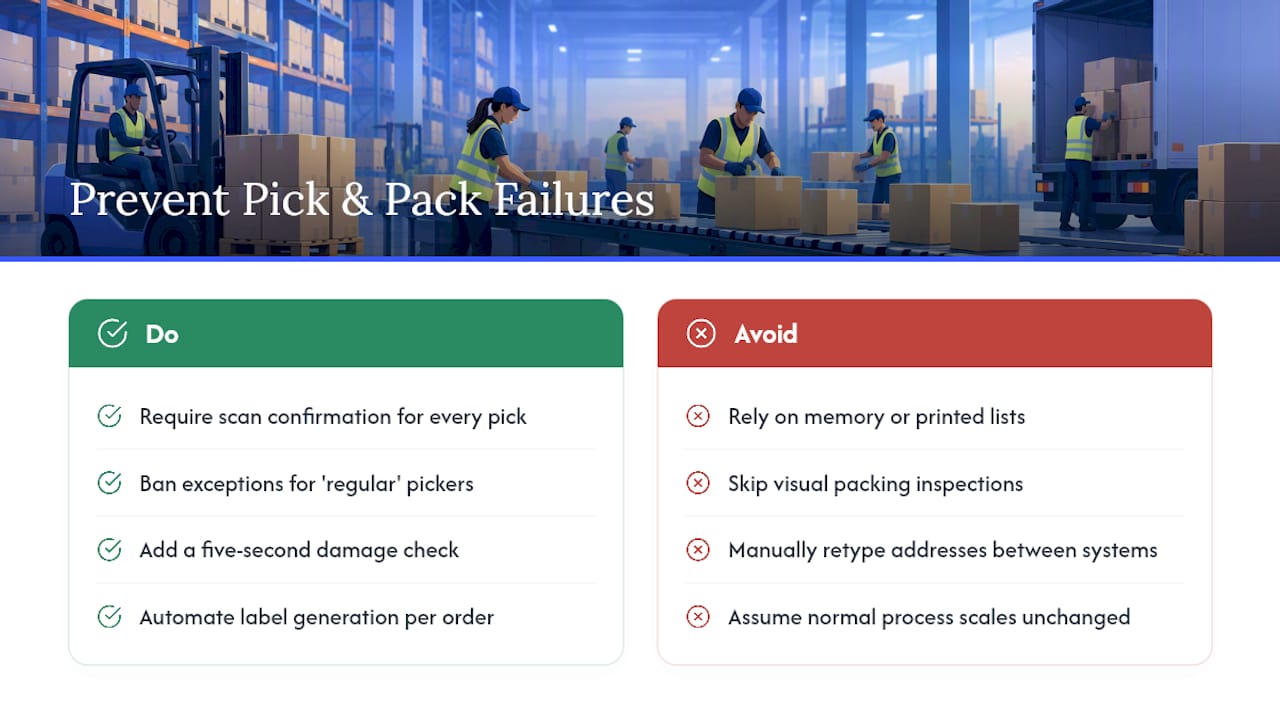
Mis-picks happen most often when a picker relies on memory or a printed list instead of scan confirmation. The fix is procedural: no item leaves its slot without a scan match, no exceptions for "regulars" who know the SKU by heart.
Incorrect put-away creates phantom inventory, where the system says a SKU is in one location but it's physically somewhere else. This compounds over time because every picker who searches that wrong slot wastes minutes, and eventually gives up and reports a false stockout.
Damaged goods shipped anyway usually means packing verification skipped a visual inspection step under time pressure. Building a five-second damage check into the packing workflow costs almost nothing and prevents a return that costs considerably more.
Address and label mismatches often stem from manual data entry between systems that don't talk to each other. Automated label generation tied directly to the order removes this failure point entirely rather than relying on a human to retype an address correctly every time.
Peak-season breakdowns happen when a process that works fine at normal volume simply can't scale, batching logic that made sense for 200 orders a day falls apart at 2,000. The fix isn't more staff, it's testing your picking method against a simulated peak load before the actual peak arrives.
Training and Workforce Management for Pick and Pack Teams
Pick and pack roles get dismissed as unskilled labor more often than they should be, and that assumption is exactly why training gets shortchanged. A new picker needs structured onboarding on scanner use, pick list navigation, and what to do when a scan mismatch occurs, not just a five-minute walkthrough on their first day.
Cross-training pickers and packers on both roles pays off during peak periods, when you need to shift labor fluidly between stages without waiting for a formal reassignment. Building a simple certification path, where staff earn the right to handle higher-value or fragile SKUs after demonstrating consistent accuracy, gives workers a reason to care about their error rate beyond just "management says so."
Shift scheduling matters more than most workforce plans acknowledge. Picking accuracy tends to drop measurably in the final hour of a long shift, so staggering breaks and rotating pickers between physically demanding zones and lighter tasks keeps error rates flatter across a full day. Pairing a clear incentive structure, tied to accuracy rather than pure speed, with regular feedback on individual error patterns tends to outperform generic productivity bonuses that inadvertently reward rushing.
Why Pick and Pack Accuracy Drives Customer Satisfaction and Returns
A wrong item, a missing item, or a damaged package rarely results in a quiet complaint. It results in a return, a refund, and often a customer who doesn't order again. Pick and pack accuracy is one of the few operational metrics that customers actually feel directly, since they never see your warehouse layout or your picking method, but they absolutely notice when the wrong shirt size shows up.
Returns triggered by fulfillment error cost more than returns triggered by customer preference, because a fulfillment error return usually comes with a refund, a reship, and a customer service interaction stacked on top of the original shipping cost. That compounding cost is why accuracy improvements at the pick and pack stage tend to pay for themselves faster than almost any other operational fix a warehouse can make. Customers rarely leave a negative review over slow shipping alone, but a wrong item nearly always generates one, because it signals carelessness rather than just delay.
Cost Breakdown: What Pick and Pack Actually Costs Your Business
Labor is typically the largest line item in pick and pack operations, and within labor, picking itself consumes the majority of hours since it involves physical travel through the warehouse that packing doesn't. Packaging materials come second, and this is where dimensional weight surcharges quietly inflate costs for operations still using one-size-fits-all boxes.
Technology costs, WMS licensing, barcode scanners, label printers, are usually a smaller recurring expense than labor but deliver outsized returns when they reduce error-driven returns and reshipments. A subscription-based platform often makes more financial sense than large upfront hardware investments for growing e-commerce operations, since it scales with order volume rather than requiring a lump capital outlay before you know your true peak demand.
Hidden costs deserve attention too. Returns processing, customer service time spent resolving fulfillment errors, and the labor cost of re-picking a mis-packed order all belong in a true cost-per-order calculation, even though they rarely appear on a standard fulfillment invoice. Operations that only track direct labor and shipping costs consistently underestimate their real cost per order, sometimes by a wide margin, because these secondary costs stay buried until someone actually audits a full quarter of return data.
A 30/60/90 Day Plan for Fixing Pick and Pack
Start with a one-day floor audit to find your actual bottleneck. Fix accuracy in the first 30 days, throughput in 60, and cost per order by 90. Train staff on the "why," not just the steps. Change sticks when people understand the problem it solves.
— Julius
Get Started With OrderKrab's Pick and Pack Software
Manually re-keying tracking numbers, hunting for the right box size, and chasing down a mis-pick after a customer complaint all cost time that a properly connected system removes from the workflow. OrderKrab integrates checkout, inventory, mobile pick lists, and carrier label generation into one platform, so a picker scans an item once and the system handles verification, labeling, and carrier assignment from there using your own carrier contracts.
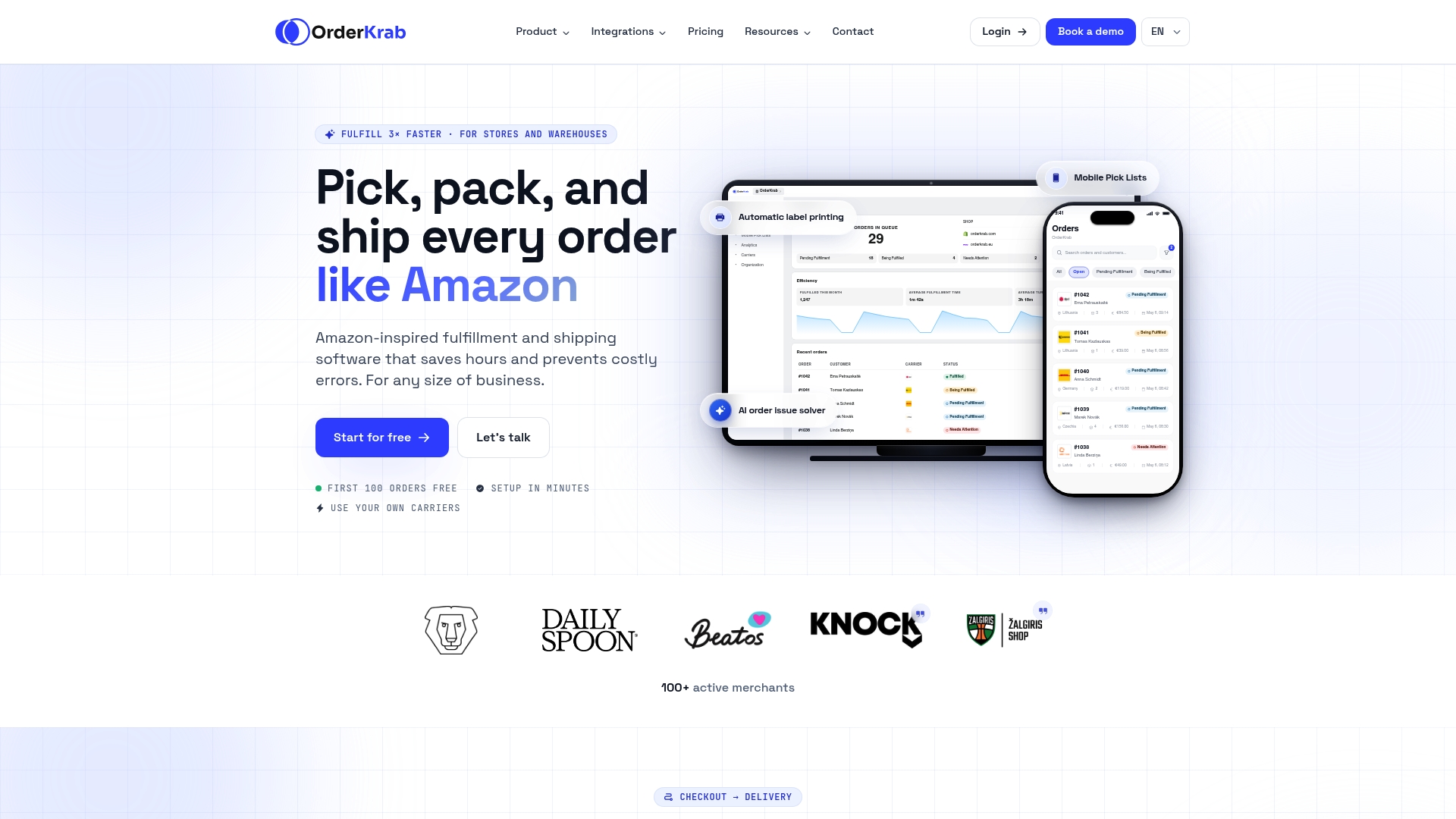
Warehouses running the WAREHOUSE plan get per-order pricing starting at €0.07 per order, while smaller merchants can start free and scale into the LABELS or PRO plans as order volume grows. If you're running a 3PL operation juggling multiple client accounts, the 3PL fulfillment tools are built specifically for that billing complexity. Check current pricing and find the plan that matches your order volume today.
This article is general information, not a substitute for advice from a qualified lawyer. Consult a qualified legal professional about your own circumstances before acting on anything here.
Sources
- Lithuania EPR guidance (LAPPA)
- Evaluating the benefits of picking and packing planning integration
- GS1 2D barcode playbook for retail POS and backend systems
- Warehouse management optimization using slotting and picking strategies (JIEM)
FAQ
What Is Pick and Pack?
Pick and pack is the warehouse process of retrieving ordered items from storage (picking) and preparing them for shipment (packing), including verification, boxing, and labeling. It sits between receiving/put-away and shipping in the broader fulfillment workflow.
What Are the Steps of the Order Fulfillment Process?
The core stages are receiving, put-away, picking, packing, and shipping, with order processing and returns handling often counted as additional steps depending on how a business defines its workflow. Each stage has its own failure points, and most errors trace back to a skipped scan at a handoff between stages.
Is Pick and Pack Work Hard?
Pick and pack work is physically demanding, involving repetitive walking, lifting, and scanning throughout a shift, and accuracy tends to drop during the final hour of a long shift. It's not intellectually complex, but sustained accuracy under time pressure is a genuine skill that benefits from structured training rather than informal on-the-job learning.
What Are the Five Main Warehouse Processes?
The five core processes are receiving, put-away, inventory storage, picking, and packing/shipping. Some operations also treat returns processing as a sixth core function given how directly it ties back into pick and pack accuracy.
How Does OrderKrab Help With the Pick and Pack Process?
OrderKrab combines mobile pick lists, barcode scan confirmation, and automated carrier label generation into one platform so pickers and packers work from a single connected system instead of switching between tools. Current pricing details are available on OrderKrab's site, including a free tier for lower order volumes.